Introduction: Why How Interior Design Affects Mental Health Mintpaldecor Matters More Than You Think
The concept of how interior design affects mental health mintpaldecor goes far beyond decoration. It is rooted in environmental psychology, neuroscience, and behavioral science. Your home is not just a physical structure it is a continuous sensory system shaping your emotions, focus, stress levels, and even decision-making.
According to the American Psychological Association, human behavior is strongly influenced by environmental cues. This means your lighting, layout, colors, and clutter levels are constantly shaping your mental wellness at home, whether you notice it or not.
This guide explains the psychological effects of interior design, how to build a healthy living environment, and practical steps for creating a comfortable home atmosphere that supports emotional stability and long-term wellbeing.
1. Emotional Comfort and a Healthy Living Environment
A truly effective home design begins with emotional comfort. When a space feels safe, predictable, and visually balanced, your nervous system naturally relaxes.
A healthy living environment typically includes:
- Balanced lighting conditions
- Organized spatial layout
- Reduced visual clutter
- Soft textures and calming materials
When these elements align, they create supportive living spaces that reduce stress and improve emotional regulation.
2. Mood-Enhancing Decor and Creating a Positive Living Space
Mood-enhancing decor plays a critical role in shaping emotional experience. Every decorative choice sends signals to your brain.
Research from Verywell Mind – Color Psychology shows that color directly influences emotional response.
Emotional effects of decor choices:
- Soft tones → relaxation and calmness
- Warm tones → comfort and energy
- Neutral palettes → stability and clarity
A carefully designed interior creates a creating a positive living space where emotional balance becomes natural rather than forced.
3. Relaxation Spaces and Interior Design for Emotional Wellbeing
Dedicated relaxation spaces are essential in modern homes. Even a small corner can significantly improve mental recovery.
A well-designed relaxation space supports:
- Stress reduction
- Emotional reset
- Mental clarity
This is closely tied to interior design for emotional wellbeing, where spaces are intentionally created to restore psychological balance.
4. Natural Lighting and How Natural Light Affects Mental Health at Home
One of the strongest influences in how natural light affects mental health at home is its impact on circadian rhythm regulation.
Learn more:
👉Sleep Foundation – Circadian Rhythm
Benefits of natural lighting:
- Improved sleep quality
- Increased energy levels
- Enhanced mood stability
Poor lighting conditions can lead to fatigue, low motivation, and emotional imbalance.
This makes natural lighting one of the most critical elements in wellness-focused home design.
5. Decluttered Interiors and Stress-Reducing Home Decor
A decluttered interiors strategy is one of the fastest ways to improve mental clarity.
Research from Princeton Neuroscience Institute confirms that clutter competes for attention and increases cognitive load.
Effects of clutter:
- Mental fatigue
- Reduced focus
- Increased stress response
This is why stress-reducing home decor focuses on minimalism, structure, and intentional simplicity.
Step-by-Step Decluttering System
Step 1: Start with one surface
Focus on a desk or table.
Step 2: Remove everything
Reset the visual space completely.
Step 3: Keep only essentials
Ask: “Do I use this regularly?”
Step 4: Create breathing space
Leave intentional empty areas.
Step 5: Maintain daily reset
5–10 minutes per day prevents buildup.
6. Comfortable Home Atmosphere and Productivity and Home Design
A comfortable home atmosphere is not just about relaxation it directly affects performance and behavior.
In productivity and home design, layout plays a major role:
- Organized desks → better focus
- Open layouts → improved communication
- Defined zones → task clarity
This creates supportive living spaces that balance both work and rest.
7. Relationship Between Interior Design and Psychology
The relationship between interior design and psychology is based on how the brain interprets environmental signals.
Learn more:
👉 Environmental Psychology – Britannica
Key psychological triggers:
- Spatial arrangement → comfort or discomfort
- Lighting → energy regulation
- Color → emotional response
These factors define the psychological effects of interior design in everyday life.
8. Interior Design Strategies for a Happier Home
Effective interior design strategies for a happier home include:
1. Optimize lighting
Prioritize natural daylight and warm ambient lighting.
2. Reduce clutter
Maintain decluttered interiors for mental clarity.
3. Introduce biophilic elements
Learn more:
👉Biophilic Design – Terrapin Bright Green
4. Improve spatial flow
Ensure easy movement and openness.
These strategies improve interior design for mental wellness and emotional stability.
9. How Colors in a Home Affect Mood and Emotions
Understanding how colors in a home affect mood and emotions is essential in interior psychology.
Color impact:
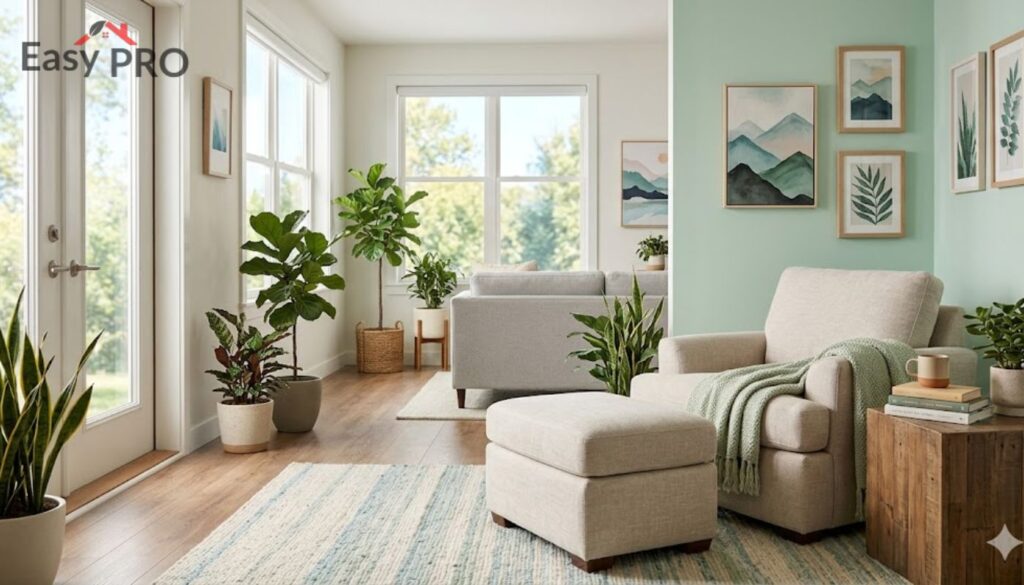
- Blue → calmness
- Green → balance
- Yellow → optimism
- Red → stimulation
This connects directly to color psychology in interior design, where emotional tone is shaped by palette selection.
10. Designing a Home for Better Mental Health and Wellbeing
Designing a home for better mental health and wellbeing requires intentional decisions:
- Increase natural light exposure
- Add natural textures and plants
- Reduce unnecessary objects
- Use calming color palettes
These changes improve mental wellness at home and long-term emotional balance.
11. Mindful Interior Design Practices and Calming Interior Design Ideas
Mindful interior design practices focus on awareness of how each object affects mental state.
Calming interior design ideas:
- Soft lighting
- Neutral color schemes
- Minimal visual noise
- Natural materials
These principles support interior design for anxiety reduction and emotional grounding.
12. Impact of Home Decor on Mood and Biophilic Design and Mental Wellness
The impact of home decor on mood is often immediate and subconscious.
Decor influences:
- Emotional tone
- Stress levels
- Sense of control
This is strengthened by biophilic design and mental wellness, which integrates:
- Plants
- Natural textures
- Organic shapes
These elements significantly enhance supportive living spaces.
13. How Home Design Impacts Wellbeing
The how home design impacts wellbeing concept shows that environment affects:
- Sleep quality
- Emotional stability
- Productivity
- Stress response
This reinforces the importance of mental health benefits of interior design as part of everyday living.
Conclusion: The Real Meaning of How Interior Design Affects Mental Health Mintpaldecor
At its core, how interior design affects mental health mintpaldecor is not about aesthetics it is about psychological engineering of space.
Your home influences:
- How you feel
- How you think
- How you recover
- How you function daily
By applying mindful interior design practices, improving natural lighting, and maintaining decluttered interiors, you create a healthy living environment that actively supports emotional wellbeing.
Final Insight
You don’t just live in your home.
Your home is also living in your mind.
FAQ
What type of lighting is best for mental wellbeing?
Natural light is best, followed by warm lighting that supports relaxation.
How does interior design affect mental health?
It influences mood, stress levels, and focus through light, color, and space organization.
Can clutter really impact mental health?
Yes, clutter increases cognitive load and can raise stress levels over time.
What colors are best for a calm home environment?
Soft blues, greens, and neutral tones generally support relaxation.
Do plants improve mental health indoors?
Yes, indoor plants reduce stress and improve mood through biophilic effects.